The Tiny Foil Packet That Quietly Rewrote the Rules of Eating Out
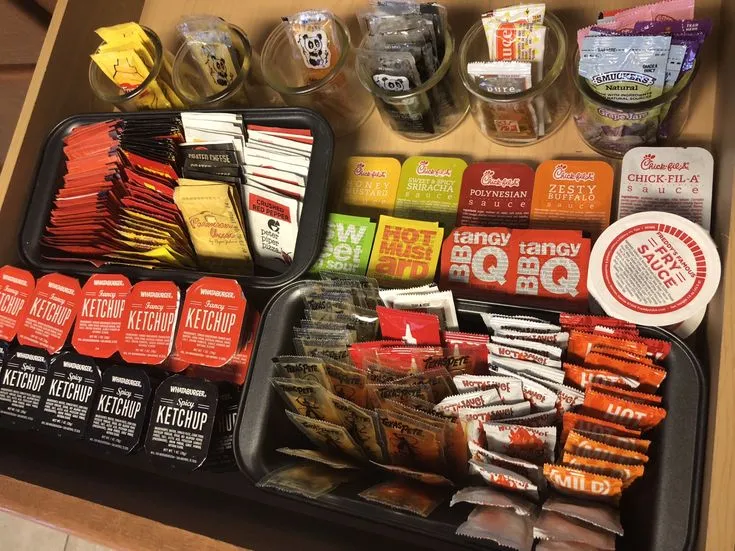
Photo: ketchup packets pile fast food restaurant table, via i.pinimg.com
There's one in your junk drawer right now. Probably several. Slightly sticky, maybe with a dried red crust on the corner. You grabbed a handful at the drive-through, used one, and stuffed the rest into your pocket without thinking. Nobody thinks about the ketchup packet. That's exactly what makes its story so interesting.
Because the ketchup packet — that thin, disposable, maddening little sleeve of condiment — didn't exist before a global war forced someone to invent it.
Glass Was a War Material
During World War II, the U.S. government needed glass for everything from optical instruments to laboratory equipment to the production of military hardware. Civilian manufacturing took a hard hit. Glass rationing became official policy, and for food companies that had always shipped their products in glass jars and bottles, this was a genuine crisis.
Ketchup makers were among the hardest hit. Heinz, French's, and dozens of regional condiment producers had built their entire logistics chains around heavy glass containers. Restaurants bought condiments in bulk glass bottles. Diners set them on tables. Customers poured them freely. It was a system so deeply embedded in American eating culture that nobody had ever questioned whether it needed to change.
The war questioned it for them.
With glass allocations slashed and tin reserved for ammunition and food rations destined for troops overseas, condiment companies faced an uncomfortable reality: they had products people wanted and no reliable way to package them. Something had to give.
The Packet Nobody Asked For
The solution that eventually emerged wasn't elegant. Early single-serve condiment packaging in the 1940s was crude — waxed paper pouches, small foil envelopes, even tiny sealed cups made from aluminum scraps. None of it worked particularly well. The pouches leaked. The foil tore unevenly. The seals failed in heat.
But the concept had been born, and once the war ended and packaging technology began catching up, manufacturers started taking the idea seriously. By the early 1950s, improved heat-sealing techniques made it possible to create a foil-and-plastic laminate pouch that could hold liquid condiments without leaking, survive shipping without bursting, and be opened with a single clean tear.
The real turning point came in 1955, when Harold Lippman — a Chicago-based packaging engineer — developed and patented a more reliable single-serve condiment packet design. His version used a multi-layer laminate that kept the contents shelf-stable, protected them from light and oxygen, and gave the packet enough structural integrity to stack, ship, and store without drama.
 Photo: Harold Lippman, via networthcolumn.com
Fast food chains, which were just beginning their explosive growth in the mid-1950s, immediately saw the appeal. No glass to break. No bottles to refill. No theft of table condiments. No mess. For a McDonald's or a Burger King trying to standardize operations across hundreds of locations, the single-serve packet was practically a miracle.
The Economics of Free Ketchup
Here's where the story gets genuinely strange. At some point in the late 1950s and early 1960s, condiment packets became free. Not discounted. Not included in a combo deal. Just — free. You bought a burger, and ketchup arrived in your bag at no additional charge, as many packets as you wanted.
This was not an accident of generosity. It was a calculated business decision that changed restaurant economics in ways that still play out today.
Condiment packets cost fractions of a cent to produce in bulk. Giving them away created powerful customer loyalty and smoothed over complaints about portion sizes, temperature, and speed. A handful of ketchup packets at the bottom of the bag made customers feel like they'd gotten something extra. It was cheap goodwill.
But it also created an expectation that has never gone away. Americans now assume condiments are free. Always. At every fast food restaurant, every diner, every food truck. The moment a restaurant tries to charge for a packet of hot sauce, the internet erupts. That expectation — so deeply wired into American eating culture that violating it feels almost rude — traces directly back to a wartime packaging scramble and the marketing decisions of the early fast food industry.
A Packet With Bigger Problems
Of course, the condiment packet isn't without its complications. Americans go through an estimated 10 billion ketchup packets per year. That's a staggering volume of single-use plastic and foil laminate, most of which is not recyclable through standard municipal programs. The environmental footprint of the humble packet has become a serious concern for sustainability advocates and food-service companies alike.
In recent years, several major chains have experimented with alternatives — larger dipping cups, pump dispensers, and even edible packaging. Heinz introduced a recyclable packet design in 2022, and the broader food-service industry has been slowly rethinking its condiment delivery systems. None of the alternatives have yet displaced the packet in the public imagination.
It remains the default. The assumed. The thing you grab without thinking.
The Junk Drawer as Historical Record
There's something almost poetic about the fact that wartime scarcity produced one of peacetime America's most reliable symbols of abundance. The ketchup packet exists because a government needed glass for weapons. It spread because fast food needed standardization. It became free because restaurants discovered that cheap goodwill was good business.
And now it lives in your junk drawer, slightly sticky, waiting for a moment that may never come — a quiet artifact of a supply chain crisis that happened eighty years ago and quietly reshaped the way an entire country eats.
Next time you grab a fistful at the drive-through window, maybe give it a second glance. That little packet has been through more history than it looks.