No Fork Required: The Messy, Gambling-Fueled Accident That Gave America Its Favorite Handheld Meal
Every American kid learns the legend somewhere around third grade: John Montagu, the Fourth Earl of Sandwich, was so addicted to the card table that he refused to leave his seat for meals. So he ordered his servants to bring him sliced meat tucked between two pieces of bread — and just like that, a culinary institution was born. It's a tidy story. It's also mostly wrong.
The actual origin of the sandwich is messier, more interesting, and says a lot more about social class, culinary confusion, and the slow, stubborn way Americans eventually learned to eat with their hands.
The Earl Didn't Invent Anything
Let's start with what we actually know. John Montagu — the real one, who lived from 1718 to 1792 — was indeed a gambler and a politician, and he did eat meat between bread. But so did basically everyone else in 18th-century England who worked with their hands. Laborers had been stuffing fillings between slabs of bread for generations. It was practical, portable, and required no silverware. The Earl didn't invent the concept. He just made it fashionable.
The story most historians trace back to a single source: a travel journal written by a man named Edward Gibbon in 1762, who observed London's elite eating what he called "a bit of cold meat" between bread while socializing at a coffee house. Gibbon mentioned that others were ordering "the same as Sandwich" — and that phrase stuck. The meal got a name not because the Earl created it, but because he popularized it among people wealthy enough to have other options.
That distinction matters. For centuries before Montagu sat down at that card table, portable bread-wrapped meals existed across cultures. Middle Eastern flatbreads wrapped around fillings, Scandinavian open-faced smørrebrød, and the Italian tramezzino all predate the English Earl by hundreds of years. What changed in 18th-century England wasn't the food — it was the social permission to eat it without a knife and fork at the table.
The Problem Was Always the Bread
Even after Montagu lent the thing his name, the sandwich faced a serious practical obstacle: the bread itself was terrible. Eighteenth-century loaves were dense, irregular, and crumbled unpredictably. Holding a meal together between two slices was an aspirational idea that the actual baking technology couldn't quite support.
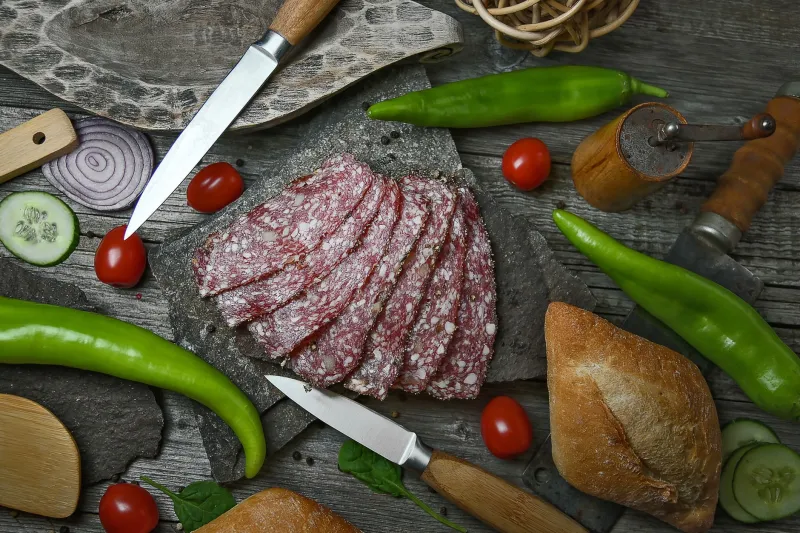
The real turning point came quietly, without fanfare, in the early 19th century. Two developments changed everything. First, bakers began producing more consistent, even-crumbed loaves thanks to improved milling techniques and standardized oven temperatures. Second — and this is the part that rarely makes the history books — the commercial availability of sliced, cured meats in urban markets made filling a sandwich far easier and more consistent than it had ever been before.
By the 1820s and 1830s, British cookbooks were including sandwich recipes for the first time. Not as novelties, but as practical meal suggestions. The handheld meal had crossed a threshold: it was now something you could reliably make at home without the whole thing collapsing into your lap.
Americans Were Skeptical — For a Very Long Time
You might assume that when the sandwich crossed the Atlantic, Americans embraced it immediately. They didn't. Early American food culture was deeply invested in the idea of the proper meal — something hot, served at a table, eaten with utensils. Eating with your hands was associated with poverty or haste, neither of which respectable households wanted to advertise.
Cookbooks from the early 1800s barely mention sandwiches. When they do, it's usually as a footnote — something you might prepare for a picnic or a journey, not something you'd serve to guests. Even Eliza Leslie, one of the most influential American cookbook authors of the 19th century, treated sandwiches as a minor category, more suited to travel than to daily life.
What finally broke the resistance wasn't a food trend. It was industrialization. As American workers flooded into factories and offices through the mid-to-late 1800s, the long midday meal — the kind you went home for — became impossible. Workers needed something fast, portable, and affordable. The sandwich, already well-established in immigrant communities who'd brought their own bread-and-filling traditions from Europe, suddenly looked like the obvious solution.
The Lunch Pail Turns the Tide
By the 1880s and 1890s, the sandwich had become the defining food of the American working lunch. Factory workers carried them in tin pails. Schoolchildren brought them wrapped in cloth. Delicatessens in New York and Chicago built entire business models around selling them across a counter.
The invention of pre-sliced bread in 1928 — introduced by the Chillicothe Baking Company in Missouri and marketed as "the greatest forward step in the baking industry since bread was wrapped" — didn't create the sandwich. But it democratized it completely. Suddenly, anyone could make a perfectly even, structurally sound sandwich in under a minute. Sales of sliced bread exploded. So did sales of sandwich fillings.
Within a decade, the sandwich had gone from a practical concession to a cultural institution. Peanut butter and jelly became the sandwich of American childhood. The club sandwich became the default lunch of American diners. The BLT became a summer ritual. None of these were accidents — they were the result of a food system that had finally caught up with a very old, very simple idea.
Why It Still Matters
The sandwich endures because it solves a problem that never goes away: people are busy, they're hungry, and they don't always have time to sit down. That was true for an English gambler in 1762, a factory worker in 1890, and a remote worker eating lunch at their desk today.
But there's something else worth noticing in this story. The sandwich didn't succeed because one person invented it. It succeeded because generations of cooks, bakers, butchers, and hungry workers refined it until it worked. The Earl of Sandwich gets the nameplate. The rest of us built the thing.