Eggs and Ideology: The Surprisingly Political History of What Americans Eat Before Noon
Ask ten Americans what they eat for breakfast and you'll get ten different answers. Eggs and bacon. A bowl of cereal. Nothing at all. Grits. A protein shake. A gas station burrito consumed at 70 miles per hour. Leftover pizza that you will not be discussing further. Breakfast in America is not a meal — it's a declaration. And like most declarations, it has a history that's a lot more loaded than it appears.
The reason Americans can't agree on breakfast isn't personal preference. It's the accumulated weight of religious doctrine, immigration patterns, regional agriculture, and some of the most aggressive food marketing in American history. What you eat before noon says more about where your family came from than it does about your morning hunger.
Before Breakfast Was Breakfast
For most of American history, there was no such thing as a distinct breakfast culture. Colonial-era Americans ate whatever was available — leftover stew, bread, cornmeal porridge, cold meat — at whatever time the farm or the household demanded. Meals were practical, not ceremonial. The idea that breakfast should be a specific category of food, distinct from lunch or dinner, is a relatively recent invention.
Through the early 1800s, the main morning meal for working families was hearty by necessity. Farm families needed caloric density before a full day of physical labor. A typical farm breakfast in the rural Midwest or South might include cured pork, eggs, cornbread, beans, and coffee. This wasn't indulgence — it was fuel. The food matched the work.
Urban families ate differently, not because they wanted to but because they had access to different ingredients and different rhythms of labor. City workers didn't burn the same calories as field workers, and they often had less time in the morning. Breakfast in urban households trended lighter and faster, even before anyone had a philosophical opinion about it.
The Seventh-day Adventists Changed Everything
In the mid-19th century, a religious community in Battle Creek, Michigan, began making arguments about food that would reshape American breakfast culture entirely — though not in the way they intended.
The Seventh-day Adventist Church, founded in the 1860s, promoted vegetarianism and temperance as spiritual disciplines. Their health reform movement, led in part by physician John Harvey Kellogg, held that meat — particularly at breakfast — was morally and physically harmful. Kellogg and his brother Will ran the Battle Creek Sanitarium, a health resort that attracted wealthy patients from across the country and served them grain-based, meat-free meals designed to cleanse and restore.
The Kelloggs developed various grain preparations to feed their patients, including a flaked wheat and corn product that patients found palatable. Will Kellogg saw commercial potential. John Harvey disagreed — he wasn't interested in selling food, he was interested in saving souls. The brothers had a falling out that became one of the great sibling rivalries in American business history, and Will went on to found the Kellogg Company and market corn flakes to the American public as a convenient, healthy breakfast food.
The pitch worked spectacularly. By the early 20th century, cold cereal had been transformed from a sanitarium food into a mainstream breakfast option, available in grocery stores across the country and backed by advertising campaigns that explicitly positioned it as a modern, scientific alternative to heavy, meat-based morning meals. The Adventists wanted to reform American morality. They accidentally invented breakfast cereal.
The Immigrant Kitchen and the Savory Morning
While Kellogg was selling corn flakes to the urban middle class, something very different was happening in immigrant communities across the country. Italian, Polish, Jewish, Greek, and Chinese immigrants brought entirely different ideas about what the morning meal should look like — and in many cases, those ideas involved nothing that would appear in a Kellogg's advertisement.
For Jewish immigrants on the Lower East Side of Manhattan, breakfast might mean herring, rye bread, and coffee. For Italian families, it was often yesterday's bread with olive oil or a small amount of whatever was left from dinner. Southern European food culture didn't recognize a sharp division between breakfast and other meals the way Anglo-American culture did, and immigrant households reflected that.
In the American South, breakfast had its own entirely separate evolution rooted in the agricultural economy of the region and the profound influence of African American cooking traditions. Grits — made from ground hominy corn — became central to Southern breakfast culture through the foodways of enslaved people, who transformed a practical grain into a dish of extraordinary versatility. Biscuits, gravy, fried chicken, and country ham all entered the Southern breakfast canon through a combination of farm economy, cultural tradition, and the specific genius of Black Southern cooks whose contributions were systematically uncredited for generations.
The Bacon and Eggs Conspiracy
By the 1920s, American breakfast had fractured into distinct regional and cultural camps: the cold cereal camp, the farm-style hot breakfast camp, the immigrant tradition camp, and the growing urban camp of people who grabbed something fast or skipped the meal entirely.
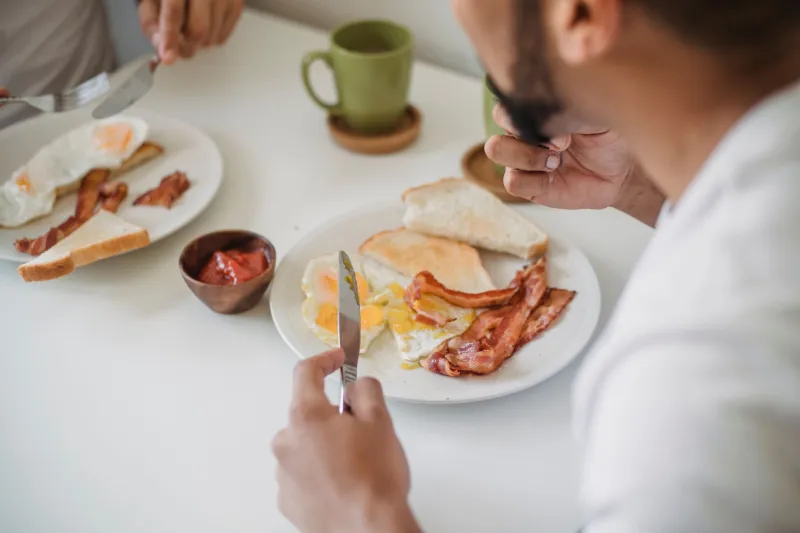
Into this chaos stepped Edward Bernays, the nephew of Sigmund Freud and arguably the father of modern public relations. In the 1920s, Bernays was hired by Beech-Nut Packing Company — a major producer of bacon — to increase sales. His solution was elegant and slightly manipulative: he commissioned a physician survey asking whether a hearty breakfast was healthier than a light one. The physicians, predictably, said yes. Bernays then publicized the survey results alongside a specific recommendation: bacon and eggs.
The campaign was enormously successful. Bacon and egg consumption rose significantly through the late 1920s and 1930s, and the combination became so culturally embedded that it now reads as timeless tradition. It isn't. It's a marketing campaign that worked so well that people forgot it was a marketing campaign.
What Your Breakfast Actually Tells You
Today, American breakfast is more fragmented than ever. Avocado toast, açaí bowls, and breakfast burritos coexist with Cap'n Crunch and gas station breakfast sandwiches. The wellness industry has revived many of the Adventists' original arguments about meat and grain in new language. Regional traditions persist: you can still track the geographic influence of Southern, Midwestern, and Northeastern food cultures by what appears on a diner menu.
But underneath all of it runs the same current that has always shaped American breakfast: the collision of belief, economics, and identity. What you eat in the morning is rarely just about hunger. It's about where your family came from, what they could afford, what they believed, and what someone once convinced them was good for them.
The cereal aisle and the diner counter are both, in their way, history lessons. You just have to know what you're reading.