The Tree Sap That Almost Vanished — and Then Became the Symbol of the American Breakfast Table
The Tree Sap That Almost Vanished — and Then Became the Symbol of the American Breakfast Table
Pour maple syrup on a stack of pancakes in almost any American diner and nobody blinks. It's one of those foods that feels ancient and inevitable, like it was always going to end up here. But the real story of how maple syrup became a fixture of the American breakfast is anything but inevitable. It's a story about borrowed knowledge, wartime desperation, a 19th-century moral crusade, and a marketing campaign so effective that it rewrote what "breakfast" means to an entire country.
Maple syrup came very close to being a footnote. The fact that it isn't is worth understanding.
The Knowledge That Was Almost Ignored
Long before European settlers arrived in northeastern North America, Indigenous peoples — including the Anishinaabe, Haudenosaunee, and Abenaki nations — had developed sophisticated techniques for harvesting and processing maple sap. They understood which trees to tap, when the sap would run, and how to reduce it into syrup and sugar through careful heating. Maple sugar, not syrup, was the primary product — dense, portable, and shelf-stable in a way that liquid syrup wasn't.
When European colonists arrived, they encountered this practice and largely treated it as a curiosity. Some settlers adopted it out of necessity when other supplies ran short, but for much of the 17th and early 18th centuries, cane sugar imported from the Caribbean was considered the proper, civilized sweetener. Maple was local and abundant, but it carried the stigma of being a workaround rather than a choice.
That attitude started shifting — slowly — for reasons that had nothing to do with flavor.
A War Changed the Sweetener
The American Revolution disrupted nearly every supply chain in the colonies, and the sugar trade was no exception. Cane sugar, which moved through British-controlled trade networks, became difficult and expensive to obtain. Suddenly, the maple trees that had been quietly dripping sap every spring looked a lot more interesting.
Colonial households that had never paid much attention to maple production began tapping trees in earnest. The practice spread beyond the Indigenous communities and frontier settlers who had always relied on it and into the broader colonial population. Maple sugar became a genuine substitute — not just a survival option, but a practical domestic product that families could produce themselves.
The shift wasn't immediate or total. When British trade restrictions eased after the war, cane sugar returned to dominance. But the experience had planted something: the knowledge that maple worked, that it was available, and that it didn't require anyone else's supply chain to produce it.
The Moral Case for Tree Sap
The most unexpected chapter in maple syrup's rise to cultural prominence involves abolition.
In the late 18th and early 19th centuries, a movement emerged among Quakers and other abolitionists arguing that purchasing cane sugar was a direct act of complicity in Caribbean slavery. The logic was straightforward: most cane sugar was produced by enslaved people on plantation islands. Buying it funded the system. The solution, some argued, was to use maple sugar instead.
Benjamin Rush, one of the Founding Fathers and a prominent physician, wrote enthusiastically about maple sugar as a free labor alternative. Abolitionist pamphlets promoted it explicitly. For a brief period, choosing maple over cane was a political statement as much as a culinary preference.
The "free produce" movement, as it was sometimes called, never fully replaced cane sugar in American kitchens — the economics were difficult and supply was inconsistent. But it gave maple a moral identity that cane sugar could never claim, and it embedded maple syrup more deeply into the cultural fabric of the northeastern United States.
How Vermont Saved It
By the mid-19th century, maple syrup production had declined significantly. Cheaper refined cane sugar and corn-based sweeteners had undercut its economic appeal. The labor required to produce it — tapping hundreds of trees, hauling sap, tending fires for hours — made less and less financial sense as industrial food production scaled up.
The tradition survived largely because of Vermont, and Vermont's survival of the tradition was partly economic stubbornness and partly brilliant positioning.
Vermont farmers who couldn't compete with Midwestern grain production leaned into what their rocky, hilly land was actually good for: dairy and maple. State agricultural programs supported maple producers. Vermont began associating its identity so thoroughly with maple syrup that the two became nearly synonymous in the American imagination. By the early 20th century, "Vermont maple syrup" wasn't just a product — it was a story, a landscape, a seasonal ritual.
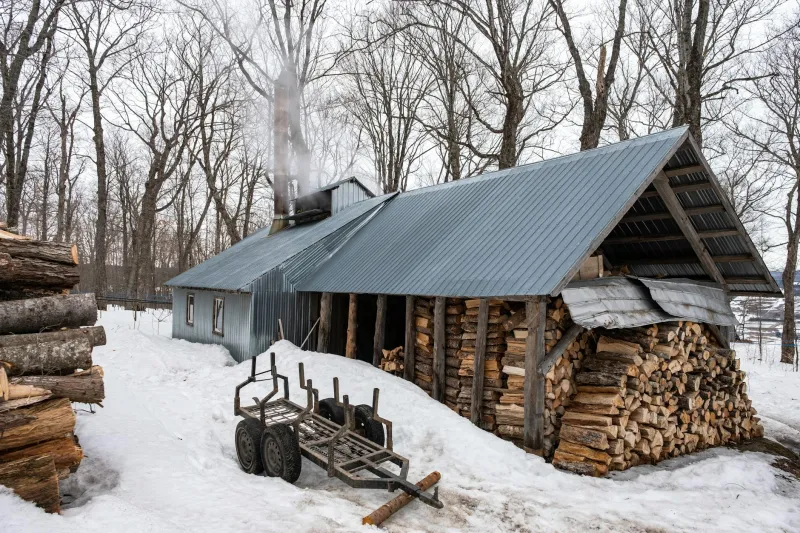
Marketing built on top of that foundation. The image of snow-covered sugar maples, wooden buckets, and steam rising from sugarhouses became shorthand for authenticity and American tradition. It was enormously effective.
What's in the Bottle Now
Today, the maple syrup industry generates over a billion dollars annually in North America, with Vermont and Canada leading production. It shows up not just on pancakes but in cocktails, salad dressings, glazes, and health food products marketed for its mineral content and lower glycemic index compared to refined sugar.
But the deeper story is about how close the whole tradition came to disappearing. Without Indigenous knowledge passed to settlers, without the disruption of a revolution, without abolitionists making a political argument for a sweetener, and without Vermont's stubborn insistence on its own identity, maple syrup might be a regional curiosity rather than a national breakfast staple.
The bottle on your table is lighter than it looks. It's carrying about three centuries of near-misses.